Simple Network Protocol is a network protocol developed by the IETF supposed to monitor and control all network components (Routers, Servers, Swicthes, Printers, hosts ect) from a central sation. It consists of a set of standards for network management, including an
application layer protocol, a database schema, and a set of data
objects. This protocol governs all communication between monitored devices and the monitoring station. SNMP describes the structure of the data packets to be sent off as well as the communication flow. In order to make this task possible, SNMP relies on:
- monitoring of IP network component
- remote control and remote configuration of network component
- error detection and notification
SNMP has by virtue of its simplicity, modularity and versatility established itself as the standard of choice to support both most of the management programmes and the hardware devices on the network.
In typical uses of SNMP one or more administrative computers, called managers, have the task of monitoring or managing a group of hosts or devices on a computer network. Each managed system executes, at all times, a software component called an agent which reports information via SNMP to the manager.
Another way of putting it is thinking of SNMP agents as snitches. Ongoing punks that rat out to the manager.
SNMP agents expose management data on the managed systems as variables. The protocol also permits active management tasks, such as modifying and applying a new configuration through remote modification of these variables, like the environment variables in windows policies which affect all users. The variables accessible via SNMP are organized in hierarchies. These hierarchies, and other metadata (such as type and description of the variable), are described by Management Information Bases (MIBs). It becomes soon obvious how MIBs dictate hierarchies in an attempt to keep the variables sorted in a neat manner. If the 5 S's were to be applied here, MIBs would be tools for 整頓 (Seiton or to sort things out).
An SNMP-managed network consists of three key components:
Managed device
Agent — software which runs on managed devices
Network management station (NMS) — software which runs on the manager
A managed device is a network node that implements an SNMP interface that allows unidirectional (read-only) or bidirectional (read and write) access to node-specific information. Managed devices exchange node-specific information with the NMSs. Sometimes called network elements, the managed devices can be any type of device, including, but not limited to, routers, access servers, switches, cable modems, bridges, hubs, IP telephones, IP video cameras, computer hosts, and printers.
Wednesday, 25 November 2015

Internet Architecture Board
The INternet Architecture Board (IAB) is a committe which is responisble for providing advisory support for and charged with oversight of the Standardised activities of the INtenet Engineering Task Force (IETF). The IAB was showing increasing interest in the long-term architectural future of the internet, so they set out to oversee the standardised processes to establish the protocol parameter values of the internet as they are known today. It is also in charge of the editorial management and publication of the Request for Comments (RFC) document series.
The body which eventually became the IAB was created originally by the United States Department of Defense's Defense Advanced Research Projects Agency with the name Internet Configuration Control Board during 1979; it eventually became the Internet Advisory Board during September, 1984, and then the Internet Activities Board during May, 1986 (the name was changed, while keeping the same acronym). It finally became the Internet Architecture Board, under ISOC, during January, 1992, as part of the Internet's transition from a U.S.-government entity to an international, public entity.
The body which eventually became the IAB was created originally by the United States Department of Defense's Defense Advanced Research Projects Agency with the name Internet Configuration Control Board during 1979; it eventually became the Internet Advisory Board during September, 1984, and then the Internet Activities Board during May, 1986 (the name was changed, while keeping the same acronym). It finally became the Internet Architecture Board, under ISOC, during January, 1992, as part of the Internet's transition from a U.S.-government entity to an international, public entity.
Monday, 23 November 2015
Text linguistics - outline
Text linguistics is a branch of linguistics whose main study is the text a communication means. The application of text linguistics has evolved from relying on grammar alone to understand the meaning in textual media to a point in which text is viewed in much broader terms that go beyond a mere extension of traditional grammar towards an entire text. Text linguistics takes into account the form of a text, but also its setting, or how it is situated in an interactional, communicative context. Both the author and the adressee are responsible for the understood meaning conveyed in the text. This means that the intended message in said text becomes subject to the way that the reader perceives it. In general it is an application of discourse analysis at the much broader level of text, rather than just a sentence or word.
Main aspects:
Intentionality - concerns the text producer's attitude and intentions as the text producer uses cohesion and coherence to attain a goal specified in a plan. Without cohesion and coherence, intended goals may not be achieved due to a breakdown of communication. However, depending on the conditions and situations in which the text is used, the goal may still be attained even when cohesion and coherence are not upheld.
Acceptability - concerns the text receiver's attitude that the text should constitute useful or relevant details or information such that it is worth accepting. Text type, the desirability of goals and the political and sociocultural setting, as well as cohesion and coherence are important in influencing the acceptability of a text. In short, that's the way how we react and interact with what we read
Informativity - concerns the extent to which the contents of a text are already known or expected as compared to unknown or unexpected. No matter how expected or predictable content may be, a text will always be informative at least to a certain degree due to unforeseen variability. The processing of highly informative text demands greater cognitive ability but at the same time is more interesting. The level of informativity should not exceed a point such that the text becomes too complicated and communication is endangered. Conversely, the level of informativity should also not be so low that it results in boredom and the rejection of the text.
Intertextuality - concerns the factors which make the utilization of one text dependent upon knowledge of one or more previously encountered text. If a text receiver does not have prior knowledge of a relevant text, communication may break down because the understanding of the current text is obscured. Texts such as parodies, rebuttals, forums and classes in school, the text producer has to refer to prior texts while the text receivers have to have knowledge of the prior texts for communication to be efficient or even occur.
https://en.wikipedia.org/wiki/Text_linguistics#Acceptability
NSFnet
The National Science Foundation Network (NSFNET) is a former programme of coordinated projects sponsored by the National Science Foundation (NSF) to develop an advanced research network, which eventually gave rise to several nationwide backbone networks to support the NST's initiative from 1986 to 1995, becoming a major internet backbone with enough public and private funding.
ARPANET
ARPANET is an acronym that stands for Advanced Research Projects Agency Network and it was an early packet switching network and the first one to implement the concept of the TCP/IP stack, originally an effort by a small research group from the MIT. ARPANET was initially funded by the Advanced Research Projects Agency (ARPA) of the United States Department of Defense. Packet switching succeded the idea of circuit switching for voice and data communications based on end to end communication. The (temporarily) dedicated line is typically composed of many intermediary lines which are assembled into a chain that stretches all the way from the originating station to the destination station. With packet switching, a data system could use a single communication link to communicate with more than one machine by collecting data into datagrams and transmitting these as packets onto the attached network link, as soon as the link becomes idle.
Friday, 20 November 2015
Gantt Chart
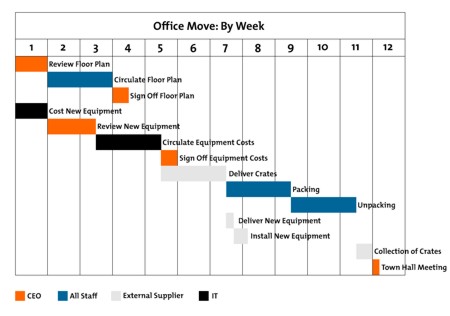
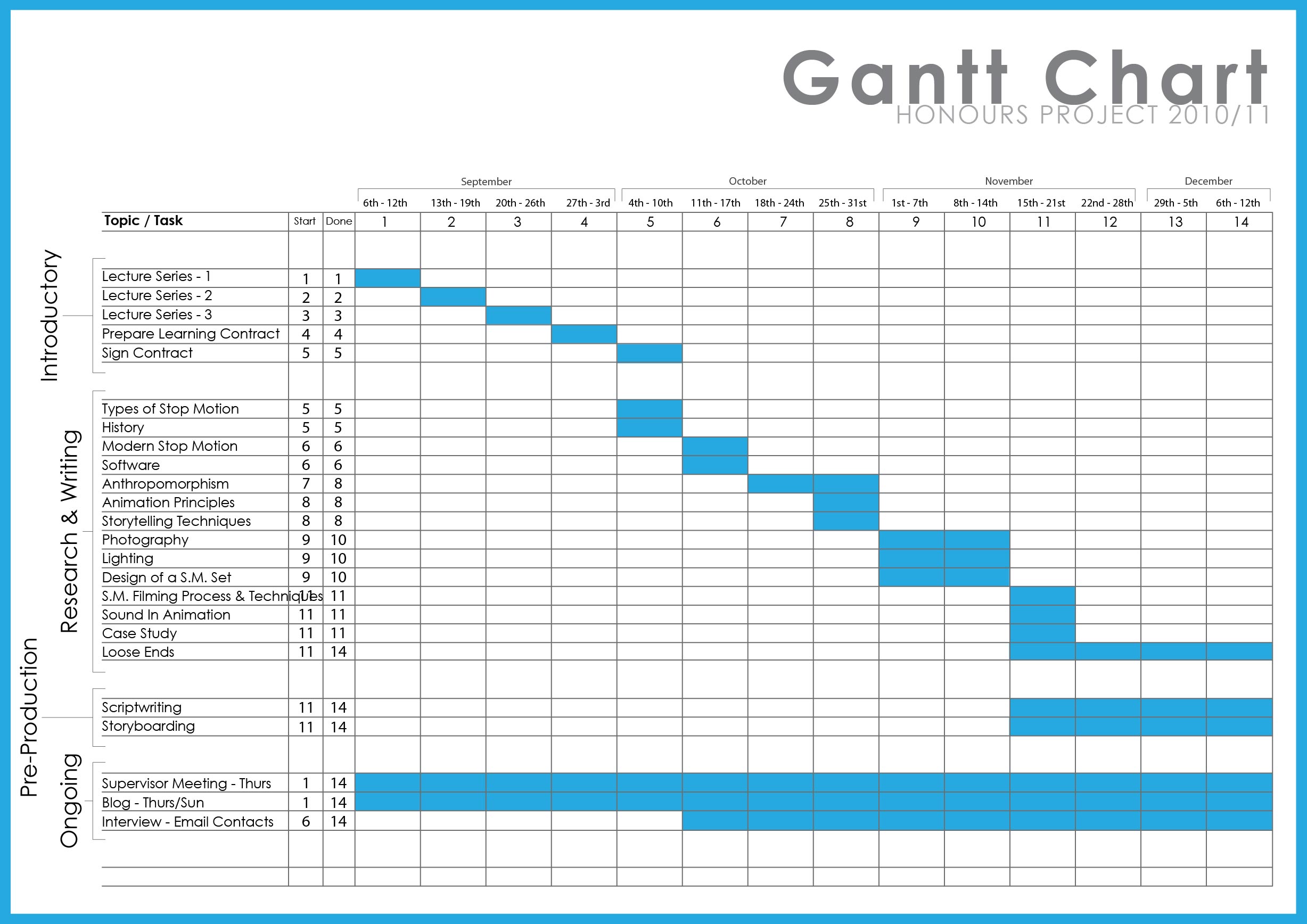
A Gantt chart is a project management tool for project activities schedule which consists of a type of bar chart. Gantt charts illustrate the start and finish dates of the work breakdown structure (the terminal and summary elements) of a project, as well as the precedence network of the activities therein (dependency). Gantt charts can be used to show current schedule status using percent-complete shadings.
Among the advantages of a gantt chart is the possibility of visualising the duration of every activity through a relationship of start to finish to every activity in the course of the project.
Examples of Gantt chart:
Among the advantages of a gantt chart is the possibility of visualising the duration of every activity through a relationship of start to finish to every activity in the course of the project.
Examples of Gantt chart:
 |
| http://www.vertex42.com/ExcelTemplates/excel-gantt-chart.html |
 |
| https://www.mindtools.com/pages/article/newPPM_03.htm |
 |
| https://mechanicalsympathy.wordpress.com/2010/10/25/gantt-chart-v1-1/ |
Sunday, 15 November 2015
Project Scope
Project Scope involves getting information required to start a project, and the features the project would have that would meet its stakeholders requirements.
In project management, the term scope has two distinct uses- Project Scope and Product Scope, with the former consisiting of the work that needs to be accomplished to deliver a product, service, or result with the specified features and functions.
An essential element of any project, project managers use the project scope as a written confirmation of the results your project will produce and the constraints and assumptions under which you will work. Both the people who requested the project and the project team should agree to all terms in the project scope before actual project work begins. In order to appeal to the main stakeholders, it should usually include the following information:
Justification: A brief statement regarding the business need your project addresses. (Save the more detailed justification for the project charter.)
Product scope description: The characteristics of the products, services, and/or results your project will produce.
Acceptance criteria: The conditions that must be met before project deliverables are accepted. In order words, your project should follow standards before the stakeholders receive the end result of your project.
Deliverables or objectives: The products, services, and/or results your project will produc.
Project Exclusions: Statements about what the project will not accomplish or produce.
Constraints: Restrictions that limit what you can achieve, how and when you can achieve it, and how much achieving it can cost.
Assumptions: Statements about how you will address uncertain information as you conceive, plan, and perform your project.
Notice that Project Scope is more work-oriented, (the hows,) while Product Scope is more oriented toward functional requirements. (the whats.) (save it for last)
Project Charter vs Project Scope:
At first glimpse both project charter and project scope seem to address the same thing. Both provide a baseline for managing and executing a project while showcasing the schedule and resources. However, bear in mind that it's the Project Charter that acknowledges the existence of a project. This means that if you only turn up the project scope without an accompanying Project Charter, your Project Scope won't be be taken seriously. Your stakeholders have to approve your Project Charter before you get ahead in the project. Moreover, without a project charter, your customer may mistakenly assume you're responsible for petty issues that are otherwise beyond your responsibilities. In order to establish in a clear way what you're supposed to do and what the project is supposed to accomplish, you should specify so in the project charter, which should be designed by the corporate executive or sponsor. The project deliverables and its objectives are statd in the Project Scope, which can only be drawn up AFTER the approval of the Project Charter.
The project scope is developed by the Project Manager with his team members.
http://www.dummies.com/how-to/content/what-to-include-in-a-project-scope-statement.html
http://www.cio.com.au/article/401353/how_define_scope_project/
Subscribe to:
Posts (Atom)